



The Origins of Diesel Power
Fittings, holders, caps — plus hundreds of parts ready for you.
Fittings, holders, caps — plus hundreds of parts ready for you.

High quality standards in fitting assemblies, ring fittings, and throttle lever components.
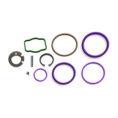
O-rings are one of the most fundamental components of industrial sealing systems and carry a significant responsibility despite their simple structure.
Used in machinery, automotive, hydraulic, and pneumatic systems, these small rings prevent liquid or gas leakage and provide excellent sealing even under high pressure and temperature conditions.
An O-ring is an elastomer (rubber) seal that takes its name from its circular “O”-shaped cross-section.
It is typically placed between two surfaces and, when compressed, seals the surfaces to prevent leakage.
With this feature, O-rings can be used in both static (between non-moving parts) and dynamic (between moving parts) applications.
Resistant to high pressure
Capable of withstanding chemicals and oils
Long-lasting and easy to install
Operates reliably over a wide temperature range
The performance of O-rings varies depending on the rubber material used. Here are the most common material types and their characteristics:
The most commonly used O-ring type
Resistant to mineral oils, fuels, and greases
Temperature range: –40°C to +120°C
Used in automotive, hydraulic systems, and general industrial applications
Known for high temperature and chemical resistance
Provides excellent protection against acids, solvents, and various fuels
Temperature range: –20°C to +200°C
Preferred in diesel injectors, fuel systems, and the aviation industry
Resistant to water, steam, and brake fluids
Not suitable for contact with oil or fuel
Temperature range: –50°C to +150°C
Commonly used in water installations and automotive cooling systems
Known for flexibility and durability at low temperatures
Used in food, medical, and electronics industries
Temperature range: –60°C to +200°C
Offers the highest chemical resistance
Maintains its shape even at very high temperatures
Typically used in industrial chemical applications and high-pressure systems
Choosing the correct O-ring is critical for ensuring reliable sealing.
The size of an O-ring is determined by its inner diameter (ID), outer diameter (OD), and cross-section thickness (CS).
Additionally, the pressure, temperature, and chemical environment of the application must be taken into consideration.
EKT Automotive offers solutions suitable for every industry with a wide O-ring stock range that complies with AS568 – DIN – ISO standards.